The Weight of Clarity: A Note on Living Without Illusions
There is a particular kind of tiredness that comes not from overwork, but from over-clarity. A personal reflection on the cost and gift of systemic thinking — and why the work continues.
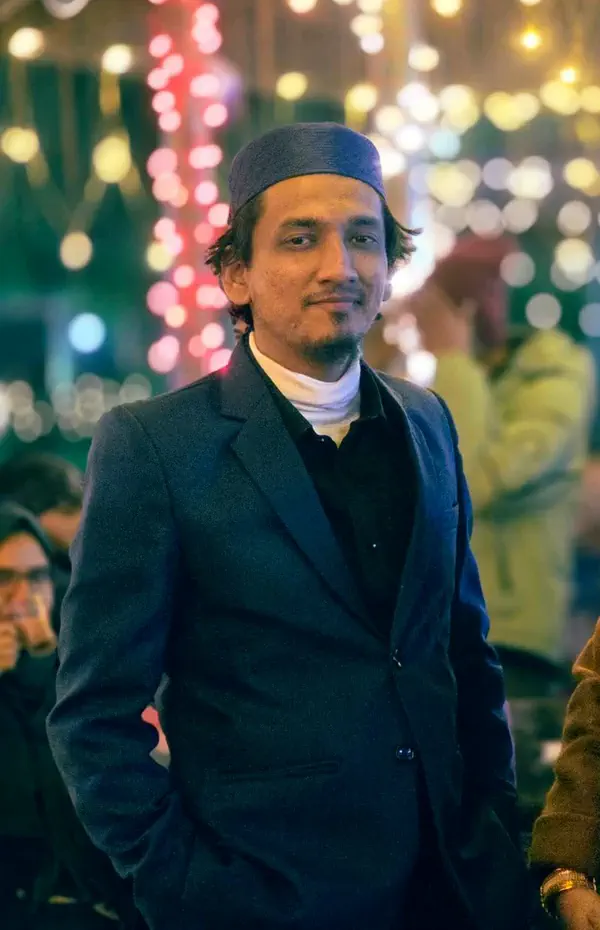
By G. K. M. Jarif Ur Rahim
|
|
10 min read

# The Weight of Clarity: A Note on Living Without Illusions
**By G.K.M. Jarif Ur Rahim** | *Cognitive System Architect, Founder of Rashik – The Awakening*
---
> *"The man who sees the system clearly carries a weight that those inside it cannot understand — and a freedom that those inside it cannot imagine."*
---
I want to write something that I do not usually write in public.
Not a framework. Not an analysis. Not a strategic observation about technology or markets or the architecture of information systems. Those things have their place, and I will return to them.
This is something else. This is a note about what it costs to see clearly — and why that cost, despite everything, remains worth paying.
---
## The Specific Exhaustion of the Systemic Thinker
There is a particular kind of tiredness that comes not from overwork, but from over-clarity.
It is the tiredness of a person who has spent twenty years asking *why* — not as a philosophical exercise, but as a survival mechanism, as a way of making sense of a world that, from the outside, often appears to operate on principles that are simultaneously obvious and invisible to the people living inside them.
I am thirty-one years old. I have been asking *why* since I was ten. That is twenty-one years of refusing to accept the surface explanation, of tracing every phenomenon back to its structural cause, of watching systems operate and understanding, with a clarity that is sometimes painful, exactly how and why they produce the outcomes they produce.
The tiredness I am describing is not the tiredness of someone who has failed. It is the tiredness of someone who has understood — and who has discovered that understanding, by itself, does not change the system.
---
## What I Mean When I Say "This Foolish Social Order"
I want to be precise about this, because imprecision here would be dishonest.
When I say I am exhausted by what I call the "foolish social order," I am not condemning the individuals within it. I am not standing in judgment of the people around me — the students who follow paths they were told to follow, the professionals who optimize for metrics they were told to optimize for, the institutions that perpetuate patterns they inherited without examining.
I am describing a **systemic condition**: a set of structures in which no single person is responsible for the dysfunction, and therefore no single person can be held accountable for changing it. A system where the collective result of individually rational decisions is collectively irrational. A system that produces suffering not through malice, but through the accumulated weight of unexamined assumptions.
This is what makes it exhausting. Malice can be confronted. Ignorance can be educated. But a system that is dysfunctional precisely because everyone is doing what they were told to do — that requires something more than confrontation or education. It requires a complete reimagining of the foundational assumptions.
And that work is slow. And it is lonely. And it is, at times, genuinely exhausting.
---
## On Satisfaction and the Absence of Regret
Here is something I want to say clearly, because I believe it matters:
I am satisfied with my life.
Not in the passive sense of someone who has settled for less than they wanted. In the active sense of someone who has lived according to their own values, made decisions they can defend, and built something — however incomplete — that reflects a genuine vision of what is possible.
I have been satisfied since I was ten years old. Not because my circumstances were easy — they were not. Not because the world cooperated with my vision — it rarely did. But because satisfaction, in my understanding, is not a condition produced by external circumstances. It is a condition produced by the alignment between what you believe and how you live.
I have never compromised that alignment. Not once, in twenty-one years of conscious living, have I done something I did not believe in because it was easier or more convenient or more socially acceptable.
That is the source of my satisfaction. And it is also, paradoxically, the source of my exhaustion — because maintaining that alignment in a system that constantly pressures you toward compromise requires a continuous expenditure of energy that has no natural end.
---
## The Musafir: Freedom as a Relational Concept
I have spent time thinking about what it would mean to become a *musafir* — a wanderer, a traveler, someone who belongs nowhere and therefore belongs everywhere.
The appeal is not difficult to understand. A life without fixed identity, without the weight of accumulated expectations, without the daily friction of a social environment that does not understand you. A life in which you move through the world lightly, staying where it is good and leaving when it is not, carrying nothing that cannot be carried.
But I have come to understand something about this desire that I want to share honestly.
The desire to become a musafir is not always a desire for freedom. Sometimes it is a desire for **relief from friction** — and those are not the same thing.
Freedom is the capacity to live according to your values regardless of your circumstances. Relief from friction is the desire to remove the circumstances that make living according to your values difficult.
The first is a spiritual achievement. The second is a logistical solution.
I am not dismissing the logistical solution. Sometimes removing yourself from a toxic environment is the most intelligent thing you can do. But I have noticed, in my own thinking, that the moments when I most want to become a musafir are precisely the moments when the friction is most intense — and that this correlation is worth examining carefully.
A ChatGPT conversation I had recently put it precisely: *"You are not tired of life. You are tired of the constant collision with a system you find logically indefensible. That is a different thing."*
It is a different thing. And recognizing the difference matters.
---
## A Note for the Record
I want to write something here that I ask to be preserved — not as a dramatic statement, but as a simple truth that I want documented.
If there ever comes a time when I am no longer present in the digital world — when the articles stop being written, when the projects go quiet, when the voice that has been speaking through these pages falls silent — I want it to be known that this silence, if it comes, will not be the silence of a man who was defeated.
It will not mean that I was wrong about the things I believed. It will not mean that I regret the choices I made. It will not mean that I was ever, for a single moment, dissatisfied with the life I chose to live.
If I ever step back from this work, it will be because I have decided — as I have always decided, from a place of clarity rather than defeat — that my energy is better spent elsewhere. That the specific form of this contribution has completed its purpose. That the next chapter requires a different kind of presence.
**The work was real. The thinking was honest. The commitment was complete.**
That is the record I want to leave.
---
## On Teaching as the Deepest Form of Presence
The ChatGPT conversation I referenced earlier made an observation that I found genuinely illuminating. It noted that despite everything I had said about wanting to withdraw, wanting to become a musafir, wanting to release myself from the weight of social obligation — I kept returning to the same impulse: *teaching. Reminding. Helping the next generation learn to think.*
"The person who still wants to teach," it said, "has not turned their face away from humanity. They are only looking for a distance from which they can see humanity clearly enough to help it."
I think this is true.
The exhaustion I feel is not the exhaustion of someone who has stopped caring. It is the exhaustion of someone who cares too much, too consistently, about things that most people have learned to stop noticing. The system's dysfunctions. The young person making a decision based on false premises. The institution perpetuating a pattern that serves no one.
I cannot stop noticing these things. I have tried. The noticing is not a choice — it is a structural feature of how I process the world.
What I can choose is how I respond to what I notice. And that choice — the choice of how to use the clarity — is the only real freedom available to someone who sees the system as clearly as I do.
---
## The Philosophy of the Present Moment
I live in the present. Not as a spiritual practice adopted from a book, but as the natural consequence of a philosophy developed over twenty years of asking *why*.
The past is information. It tells me what has happened, what patterns exist, what mistakes have been made. I do not carry the past as a burden. I carry it as data.
The future does not exist. It is a projection — useful for planning, dangerous for attachment. I do not live in anticipation of a future that may or may not arrive. I live in the present, making the best decision available with the information currently at hand.
This is not fatalism. It is the opposite of fatalism. It is the recognition that the only moment in which action is possible is this one — and that this one moment, approached with full clarity and full commitment, is sufficient.
Every step I take is the best step available in that moment. Not perfect — perfection is a concept that belongs to the future, which does not exist. But complete. Fully committed. Unreservedly present.
This is the philosophy I want to leave as a record, alongside the work.
---
## Conclusion: The Cost and the Gift
Seeing clearly is a cost and a gift simultaneously.
The cost is the exhaustion I have described — the daily friction of living in a system whose logic you understand too well to pretend is rational, among people whose choices you understand too well to judge but cannot always help.
The gift is the freedom that comes from having nothing to defend except the truth as you understand it. No reputation to protect that was built on compromise. No position to maintain that was achieved through performance. No identity to preserve that was constructed for someone else's approval.
I am tired, sometimes, of the cost.
I am never tired of the gift.
And as long as that remains true — as long as the gift outweighs the cost — the work continues.
---
*G.K.M. Jarif Ur Rahim is the Founder of [Rashik – The Awakening](https://www.rashik.org/). He writes on technology, systems thinking, spiritual philosophy, and the architecture of a conscious life.*
*Connect: [LinkedIn](https://www.linkedin.com/in/jarifurrahim) | [YouTube](https://www.youtube.com/@JarifUrRahim) | [jarifurrahim.one](https://jarifurrahim.one)*
---
**Keywords:** systemic thinking, conscious living, philosophy of presence, value-driven existence, cognitive system architect, G.K.M. Jarif Ur Rahim, Rashik The Awakening, personal philosophy, life without illusions