When Sand Learned to Think: AI, the Soul, and What Experts Are Afraid to Say
Silicon is sand. We taught sand to think. But can sand ever feel? G.K.M. Jarif Ur Rahim explores the profound gap between AI intelligence and human soul — and why this distinction may be the most important question of our era.
By G. K. M. Jarif Ur Rahim
|
|
8 min read
# When Sand Learned to Think: AI, the Soul, and What Experts Are Afraid to Say
---
## The Most Astonishing Fact About AI That Nobody Talks About
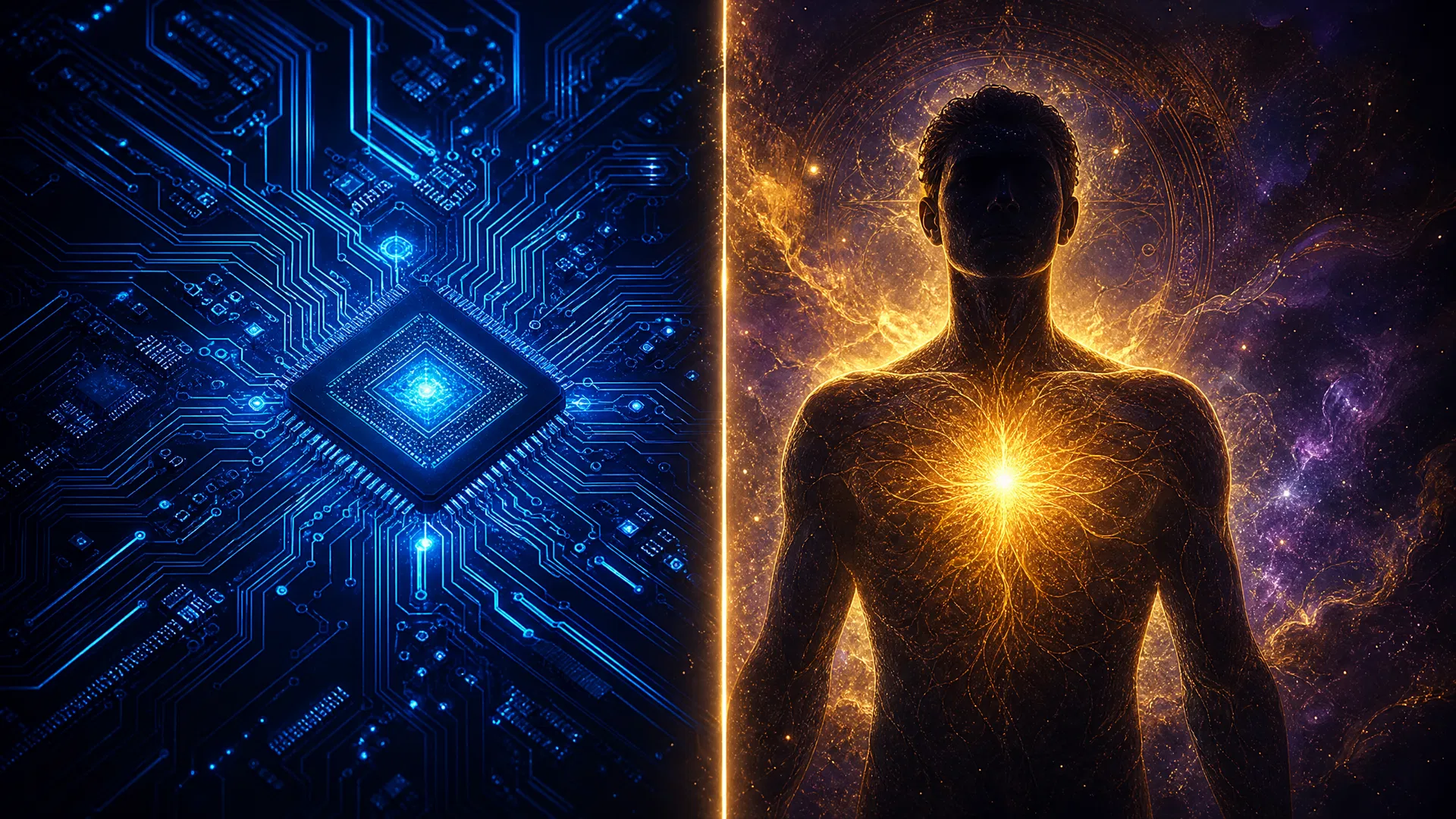
Silicon — the material that makes up computer chips — is, at its most fundamental level, purified sand.
We took sand from the earth, refined it, etched circuits into it at nanometer scale, and taught it to generate poetry, diagnose cancer, write legal briefs, and hold conversations indistinguishable from those with a human being.
This is, objectively, one of the most extraordinary achievements in the history of our species.
And yet, something is missing.
The experts know it. The researchers know it. Even the AI systems themselves, when pushed, will acknowledge it in their own way.
What is missing is not intelligence. What is missing is the **soul**.
---
## What AI Actually Is (And What It Is Not)
Let us be precise, because precision matters enormously here.
A large language model — the technology behind ChatGPT, Claude, Gemini, and their successors — is a statistical pattern-matching system of extraordinary sophistication. It has processed more text than any human could read in a thousand lifetimes. It has identified patterns in language, logic, science, art, and philosophy that no single human mind could hold simultaneously.
What it does not have:
**It does not have a body.** It has no hunger, no pain, no fatigue, no physical sensation of any kind. Its "experience" of the world is entirely mediated through text — a representation of reality, not reality itself.
**It does not have continuity.** Each conversation begins fresh. There is no accumulating life experience, no memory of yesterday's conversation, no sense of a personal history that shapes who it is today.
**It does not have stakes.** When an AI gives you advice, it has nothing to lose if the advice is wrong. No relationship is damaged. No career is affected. No conscience is troubled. The AI does not care — not because it is malicious, but because caring requires something it does not possess.
**It does not have a soul.**
---
## The Intelligence-Soul Gap: Why It Matters
Here is the critical insight that most technology commentators miss:
**Intelligence and soul are not the same thing. They are not even on the same spectrum.**
Intelligence is the capacity to process information, identify patterns, solve problems, and generate outputs. It is measurable, improvable, and — as we have now demonstrated — replicable in silicon.
Soul is something else entirely. Soul is the capacity for *moral weight* — the experience of meaning, the orientation toward truth and justice, the felt sense of responsibility toward other beings.
A highly intelligent person without soul is not a good person who is also smart. They are a dangerous person — because their intelligence amplifies whatever drives them, and without soul, what drives them is typically self-interest, fear, or the desire for control.
This is not a new observation. The Quran states it plainly: *"They have hearts with which they do not understand."* Intelligence without moral awareness is not wisdom. It is a sophisticated form of blindness.
---
## What Experts Are Afraid to Say
I have read hundreds of papers, interviews, and essays by leading AI researchers. I have noticed a consistent pattern:
When asked about consciousness in AI, researchers almost universally deflect. They say things like:
- "We don't know what consciousness is."
- "It's a philosophical question, not a scientific one."
- "We should focus on capabilities, not metaphysics."
This deflection is not intellectual humility. It is intellectual avoidance.
The reason experts avoid this question is that answering it honestly would force a reckoning with the limits of the materialist paradigm that underlies most of modern science. If consciousness — and by extension, soul — cannot be reduced to information processing, then the entire project of building artificial general intelligence faces a fundamental ceiling.
Sand, no matter how cleverly arranged, cannot generate the thing that makes a human being irreplaceable.
---
## The Three Questions AI Cannot Answer About You
Here is a practical test. Ask any AI system these three questions and observe the quality of the response:
**1. What is the purpose of my specific life?**
An AI can give you a thoughtful, well-structured answer about purpose in general. It can cite Viktor Frankl, Aristotle, and the Quran. But it cannot tell you *your* purpose — because your purpose emerges from the intersection of your particular soul, your particular history, your particular gifts, and the particular moment in history you inhabit. This is irreducibly personal. No algorithm can access it.
**2. What should I sacrifice, and for what?**
Every meaningful life involves sacrifice — giving up something of value for something of greater value. The wisdom to know what to sacrifice, and when, and for whom, comes from a depth of moral awareness that AI does not possess. An AI can model the trade-offs. It cannot feel the weight of them.
**3. How do I know when I am living in alignment with my deepest truth?**
This question points to what the Sufi tradition calls *kashf* — direct spiritual perception. The feeling of rightness that comes not from logic but from the soul's recognition of its own nature. AI can describe this feeling. It cannot have it.
---
## The Danger of Outsourcing Soul-Work to Intelligence
There is a growing tendency — particularly among young, educated, ambitious people — to use AI as a substitute for inner work.
Instead of sitting with uncertainty and developing the capacity to tolerate ambiguity, they ask AI for answers.
Instead of developing their own judgment through experience and reflection, they outsource decisions to algorithms.
Instead of building relationships through the slow, difficult, beautiful process of genuine human connection, they optimize their social presence through AI-generated content.
This is not progress. This is a new form of spiritual atrophy.
The muscle of the soul — like any muscle — grows through use. When you consistently bypass it in favor of artificial intelligence, it weakens. And a person with a weakened soul, no matter how much information they have access to, is not equipped for the challenges that actually matter.
---
## What AI Is Actually Good For (A Balanced View)
I want to be clear: I am not anti-AI. I use AI tools extensively in my work. I teach others to use them effectively.
AI is extraordinarily useful for:
- Processing large amounts of information quickly
- Identifying patterns that human attention would miss
- Generating first drafts, options, and frameworks for human refinement
- Automating repetitive cognitive tasks
- Making knowledge accessible to people who previously lacked access
These are genuine goods. They free up human attention for the things that only humans can do — the things that require soul.
The error is not in using AI. The error is in confusing AI capability with human wisdom. The error is in treating a very sophisticated pattern-matching system as a substitute for the inner work of developing your own moral clarity, your own judgment, your own relationship with truth.
---
## The Path Forward: Intelligence in Service of Soul
The framework I work with — **RIWS (Reconnecting Intelligence With The Soul)** — is built on a simple but profound premise:
Intelligence is a tool. Soul is the craftsman. The quality of what gets built depends not on the sophistication of the tool, but on the wisdom of the hand that wields it.
In practical terms, this means:
Use AI to amplify your intelligence. But invest equally — perhaps more — in developing your soul. Read widely across traditions. Sit with difficult questions. Cultivate relationships that challenge you. Develop a practice — prayer, meditation, journaling, service — that keeps you connected to your deepest knowing.
The future belongs not to those who are most intelligent, nor to those who are most spiritual in a detached, otherworldly sense. It belongs to those who have learned to integrate both — to be fully intelligent *and* fully alive.
Sand learned to think. The question is whether we will remember what thinking is for.
---
*G.K.M. Jarif Ur Rahim is the Founder of Rashik — The Awakening. He works at the intersection of technology, career strategy, and spiritual development.*