Editor’s Note: This essay is part of the broader Binary Interface of Consciousness (BIC) research pathway, where questions of AI, consciousness, free will, decision-making, and the relation between intelligence and soul are explored through philosophy, neuroscience, and theoretical modeling.
Introduction: The Question That Defines Our Age
A few years ago, if someone had asked you — "Will a computer algorithm make the most important decisions of your life?" — you might have laughed it off. Today, that question is no longer hypothetical.
Yuval Noah Harari, the world-renowned historian and philosopher behind Sapiens, Homo Deus, and 21 Lessons for the 21st Century, has painted a compelling picture of a future where humans surrender their most consequential choices — whom to marry, which career to pursue, where to live — to algorithms. His reasoning: algorithms will know us better than we know ourselves.
This claim has resonated with millions across the globe. It feels intuitive, even inevitable, in an age where Netflix predicts what you want to watch before you decide, and Spotify curates your mood before you name it. But within this compelling argument lies a subtle gap — a point where Harari's logic quietly stops short. And identifying that gap changes how we understand both the power of AI and the depth of human consciousness.
Harari's Core Argument: What Is Dataism?
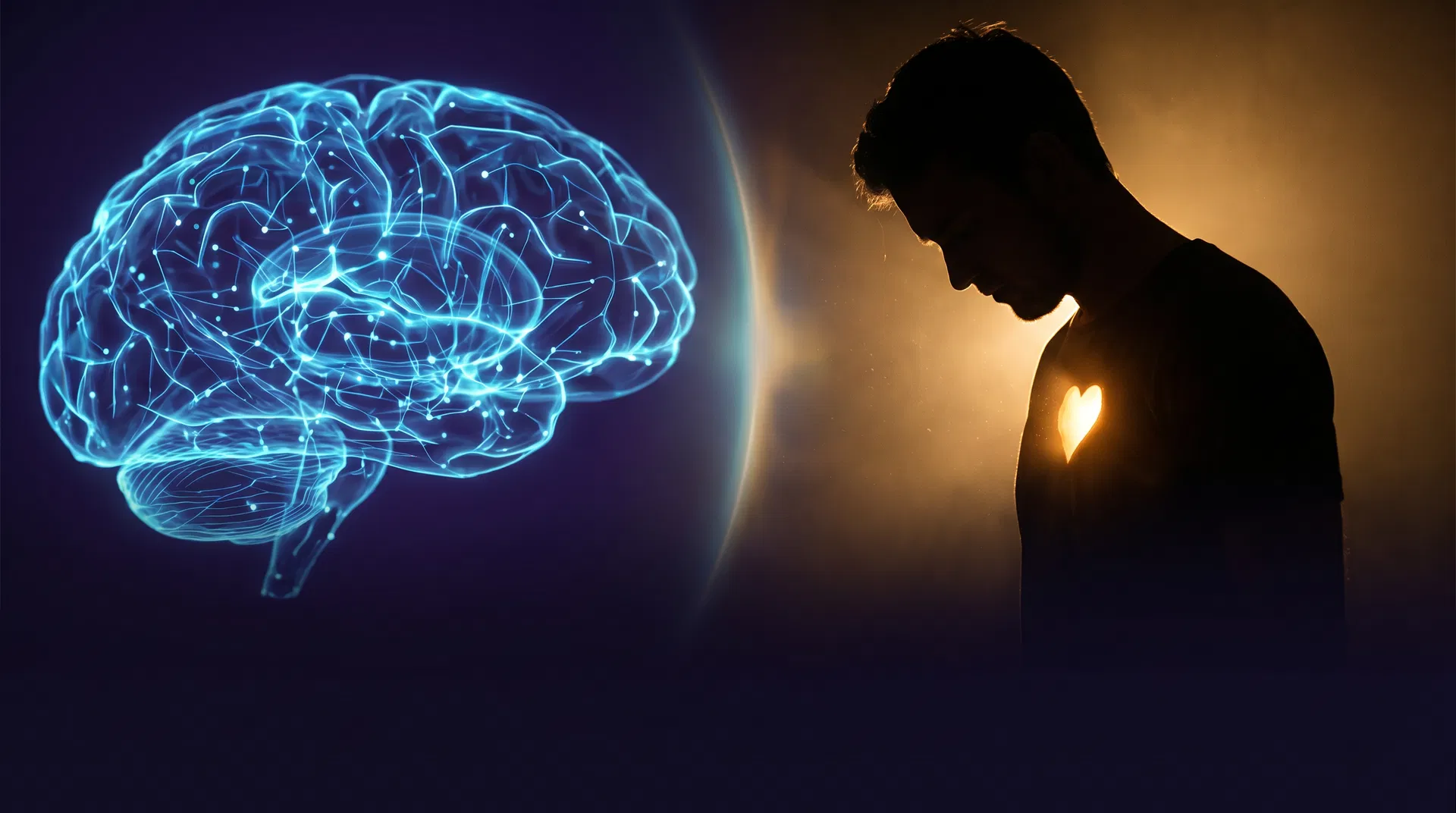
Harari's philosophy of Dataism rests on a provocative premise: the universe, at its most fundamental level, is a system of data processing. Humans, in this framework, are sophisticated "biochemical algorithms" — the product of evolutionary programming, hormonal signals, and neural patterns.
His argument stands on three pillars. First, the human brain cannot retain all the data it encounters — but AI can. Second, human decision-making is compromised by emotion, cognitive bias, and incomplete information — while algorithms remain neutral and comprehensive. Third, given sufficient data, AI will be able to predict a person's next move, preference, and behavior more accurately than that person could predict it themselves.
Read in isolation, these points seem difficult to refute. But this is precisely where we need to pause.
The Question Harari Didn't Ask
Harari presents the human brain's inability to store all information as a weakness. But this raises a fundamental question: Is forgetting actually a weakness, or is it evidence of a more sophisticated processing system?
Consider why a computer requires such enormous memory. It is because the machine cannot derive future outcomes without retaining past data. Remove the stored information, and its conclusions change. The computer's need for massive storage is not a sign of strength — it is a symptom of systemic limitation.
The human brain operates differently. When a person forgets an experience, the essence of that experience does not disappear. It integrates into character, judgment, and intuitive response. The data may be gone, but its influence on outcomes remains — and often becomes more refined over time. This is not an inferior system. This is a different kind of intelligence — one that transcends raw data retention and operates at the level of distilled wisdom.
Where the Algorithm Ends
Harari's claim that AI will know us better than we know ourselves is partially true — but only for a specific kind of person.
For someone who has gradually allowed technology to pattern their behavior, whose preferences and reactions have become predictable and algorithmically legible, AI will indeed be able to anticipate their choices. But this is not because AI is superior to human consciousness. It is because that person has, in a sense, become algorithmic themselves.
For the person who remains genuinely human — whose inner life includes creativity, spiritual depth, moral struggle, and the capacity for unexpected transformation — no algorithm will achieve complete understanding. Because such a person moves beyond pattern. They surprise themselves. They transcend their own history. The deepest layers of human consciousness — what philosophers, theologians, and contemplative traditions across cultures have called the soul, the ruh, or pure awareness — are not measurable. And what cannot be measured cannot be stored, predicted, or replicated.
The Deepest Problem: Free Will as "Illusion"
Harari takes his argument one step further, declaring human free will to be an "illusion" — a narrative we tell ourselves about choices that are, in reality, the deterministic output of neurochemical processes.
This perspective has a certain scientific validity within a reductionist framework. But it does not capture the full picture of human experience.
Consider the moment a person acts against their own self-interest to help a stranger. Consider the artist who creates something genuinely new — not a recombination of existing patterns, but a true emergence. Consider the individual who, through deep reflection or prayer, arrives at a clarity that no algorithm could have predicted. These moments are real. They are documented across human history in every culture and tradition. And they exist beyond the reach of any predictive model.
A Comparison Worth Making
DimensionAI / AlgorithmHuman ConsciousnessData RetentionComplete, persistentSelective, integrativeDecision BasisPattern recognitionValues, intuition, wisdomPredictabilityHigh (for patterned behavior)Low (for genuine human depth)AdaptabilityWithin trained parametersBeyond known parametersMoral AgencyNoneCentralSpiritual CapacityNoneFundamental
This table does not suggest that AI is inferior in every dimension. It illustrates that AI and human consciousness operate in different domains — and that conflating the two leads to the kind of category error at the heart of Harari's Dataism.
What AI Is — And What It Is Not
This analysis is not an argument against artificial intelligence. AI is a remarkable tool — and when applied wisely, it holds extraordinary potential for human flourishing. It can process information at scales no human can match, identify patterns invisible to the naked eye, and augment human capability in ways previously unimaginable.
But a tool is not a decision-maker. AI can analyze, predict, and optimize. It cannot choose based on values. It cannot weigh the moral weight of a decision against a framework of meaning and purpose. It cannot ask — "What kind of person do I want to be?" — and act accordingly.
The greatest danger in Harari's Dataism is not that it is entirely wrong. It is that it is persuasive enough to make people doubt their own capacity for judgment. And when people stop trusting their own consciousness, they genuinely do become algorithmically predictable — fulfilling the prophecy not because it was inevitable, but because it was believed.
Conclusion: Intelligence and Soul — Together
Yuval Noah Harari is a thinker of extraordinary depth and reach. His contribution to our understanding of history, technology, and the human condition is immense. But Dataism, in reducing human beings to biochemical algorithms, commits a fundamental philosophical error: it mistakes the map for the territory.
Human beings are not merely data processors. We seek meaning. We form connections. We experience beauty, grief, wonder, and transcendence. These are not inefficiencies to be optimized away. They are the very substance of what it means to be human.
The future belongs neither to those who reject technology nor to those who surrender to it. It belongs to those who can hold both — who can harness the power of intelligence while remaining rooted in the depth of the soul.
This is the philosophy of Rashik — Reconnecting Intelligence With The Soul.