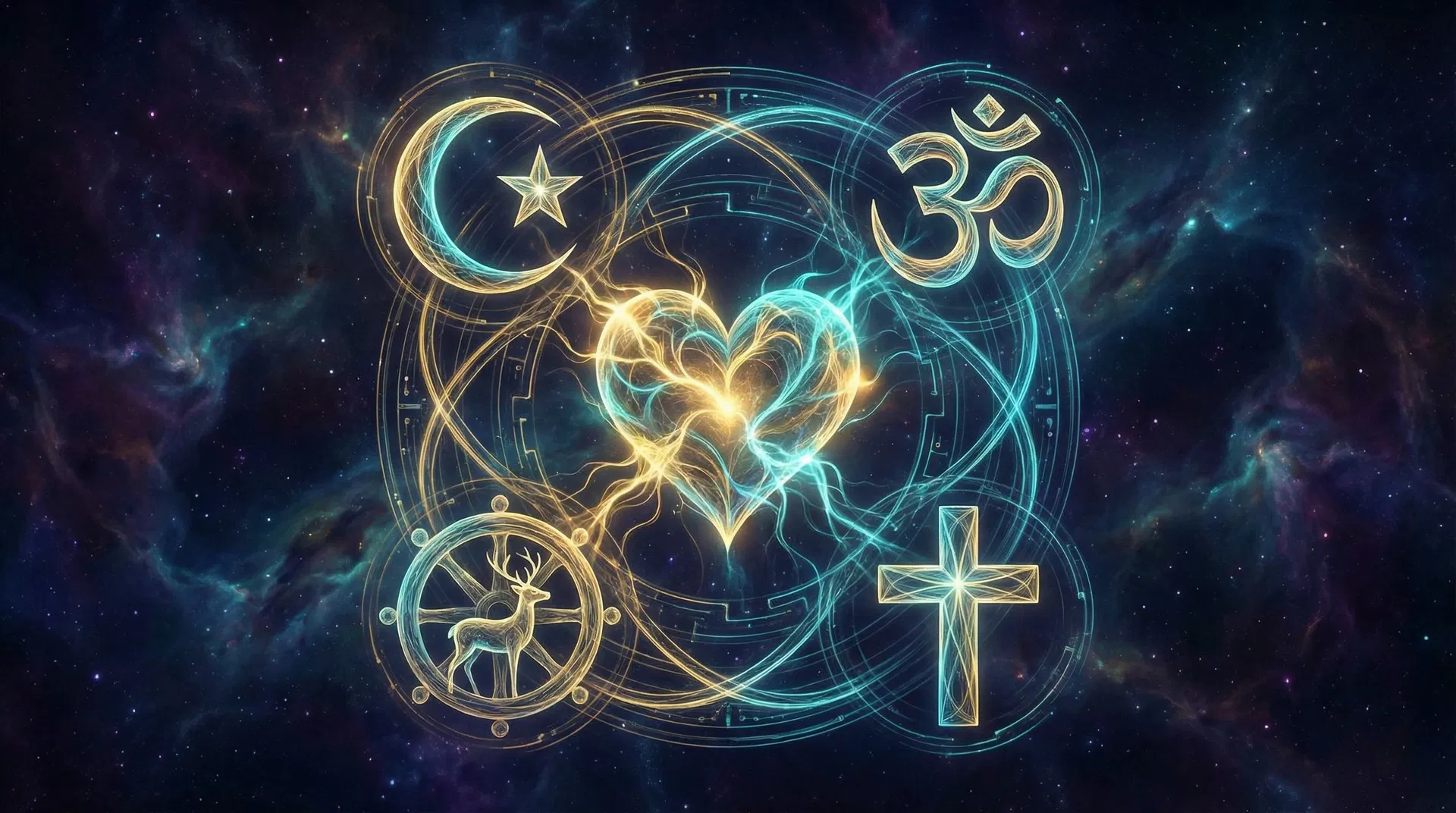
What if the world's oldest wisdom traditions — separated by thousands of years, thousands of miles, and radically different languages — all described the same architecture of human consciousness? Not metaphorically similar, but structurally identical?
This is the central finding of the first paper in the Binary Interface of Consciousness (BIC) research series by G.K.M. Jarif Ur Rahim, published on Zenodo (DOI: 10.5281/zenodo.19115380). The paper presents a three-layer model of consciousness — Soul as Software, Brain as Hardware, Heart as Interpreter-Kernel — and demonstrates that this architecture is not a modern invention but a rediscovery of what Islamic, Hindu, Buddhist, and Western traditions have described for millennia.
The Three-Layer Architecture
The BIC framework proposes that human consciousness operates through three distinct functional layers, each with a specific role:
| Layer | Function | Analogy |
|---|---|---|
| Software (Soul/Ruh) | Provides the core evaluative criterion — the moral and intentional compass | Operating system that defines what the machine should do |
| Hardware (Brain) | Generates probabilistic candidate responses to any stimulus | Processor that calculates all possible options |
| Interpreter-Kernel (Heart/Qalb) | Collapses probabilistic states into binary decisions: Accept (1) or Reject (0) | The decisive gate that says YES or NO |
The critical insight is that the heart is not merely a pump. According to peer-reviewed research from the HeartMath Institute, the heart's electrical field is approximately 60 times greater in amplitude than the brain's, its magnetic field is 100 times stronger, and it sends more neural signals to the brain than the brain sends to it. The heart is the director — not the receiver — in heart-brain communication.
Cross-Cultural Validation: A Remarkable Convergence
What makes this framework extraordinary is that it is not derived from a single tradition. The paper demonstrates that four major philosophical systems independently describe the same three-layer architecture:
Islamic Theology: Qalb as the Interpreter
In the Quran, the word Qalb (heart) appears over 130 times — not as a metaphor for emotion, but as the seat of understanding, decision, and spiritual perception. The Qalb receives guidance from the Ruh (soul/spirit) and evaluates the brain's proposals against divine criteria. When the Qalb accepts, the person experiences yaqeen (certainty). When it rejects, the person feels doubt or unease — precisely the binary output the BIC framework describes.
Hindu Philosophy: Hridaya and Atman
The Upanishads describe the Hridaya (spiritual heart) as the dwelling place of the Atman (soul). The Hridaya is where ultimate knowledge resides — not in the mind (Manas), which generates thoughts and desires, but in the heart, which discerns truth from illusion. This maps directly to the BIC's Interpreter-Kernel receiving signals from the Software layer and evaluating the Hardware's output.
Buddhist Psychology: Citta as the Luminous Mind
In Buddhist Abhidhamma, Citta (mind/heart — the same word in Pali) is described as the fundamental unit of consciousness that arises and passes away in discrete moments. Each moment of Citta is a binary event: wholesome or unwholesome, aligned or misaligned with the Dhamma. The Buddha's teaching that the "luminous mind" is obscured by defilements parallels the BIC's concept of the Interpreter-Kernel being corrupted when it loses coherence with the Software layer.
Western Mysticism: Nous and Pneuma
In the Greek philosophical tradition, Nous (intellective heart) is distinguished from Dianoia (discursive mind/brain). The Nous receives truth directly from the Pneuma (spirit) and evaluates the mind's reasoning. This three-part structure — Pneuma, Dianoia, Nous — maps precisely to the BIC's Software, Hardware, and Interpreter-Kernel.
The Heart's Binary Output: Certainty and Doubt
Perhaps the most compelling evidence for the BIC framework is the universal human experience of the heart's binary output. Every person, regardless of culture, religion, or education, has experienced:
- Output = 1 (Accept): The feeling of deep certainty, conviction, "knowing in the heart" that a decision is right — even when the brain's logical analysis is incomplete.
- Output = 0 (Reject): The feeling of unease, doubt, "something doesn't feel right" — even when the brain's logic says the option should work.
This is not a vague metaphor. HeartMath research has measured that in states of high heart coherence, brain waves synchronise to the heart's rhythm — not the reverse. The heart is the master oscillator of the human system, and its binary evaluation function produces the subjective experience of certainty or doubt that precedes every major decision.
Why This Matters for AI
The implications extend far beyond philosophy. If the heart truly functions as a binary interpreter — and if the AI Black Box problem arises precisely because current AI systems lack this interpreter layer — then the path to transparent, trustworthy AGI may require building a Synthetic Qalb: a deterministic binary gate that evaluates every AI decision against explicitly defined ethical criteria before execution.
This is not a religious argument. It is an architectural observation validated across the world's major wisdom traditions and supported by empirical neurocardiology. The BIC framework transforms an ancient insight into a testable scientific proposition.
Read the Full Paper
The complete paper is available as an open-access pre-print on Zenodo:
Author: G.K.M. Jarif Ur Rahim | ORCID: 0009-0004-0763-322X
Series: Binary Interface of Consciousness (BIC) Research Series
This article is based on a pre-print research paper. The findings represent a working framework open to peer review and collaborative refinement. All religious references are presented with respect and scholarly neutrality.