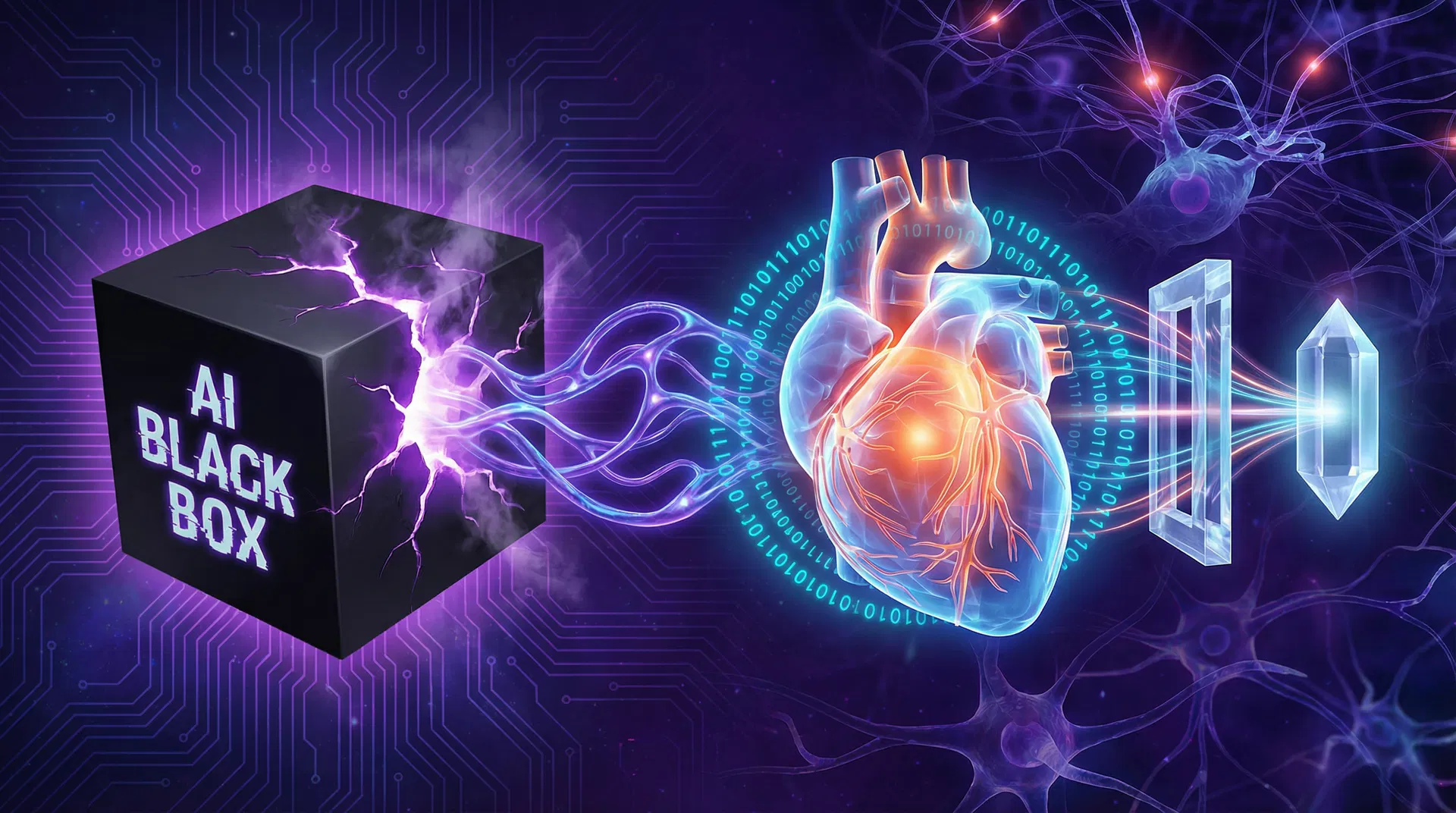
Two of the most profound unsolved problems in science — the AI Black Box problem in computer science and the Hard Problem of Consciousness in philosophy of mind — may share a single root cause. And the solution may have been hiding in our chests all along.
This is the central argument of the second paper in the Binary Interface of Consciousness (BIC) series by G.K.M. Jarif Ur Rahim (DOI: 10.5281/zenodo.19115793). The paper argues that both crises arise from the same architectural error: treating the brain (or neural network) as the complete system, while ignoring the heart's role as a deterministic binary interpreter.
Two Crises, One Root Cause
Consider the parallel:
| Problem | AI Black Box | Hard Problem of Consciousness |
|---|---|---|
| Core Question | Why can't we trace how AI reaches decisions? | Why can't we explain how brain activity produces subjective experience? |
| Root Assumption | The neural network IS the complete system | The brain IS the complete system |
| BIC Diagnosis | Missing: Interpreter-Kernel (binary gate) | Missing: Interpreter-Kernel (heart/Qalb) |
Current AI systems — from GPT to autonomous vehicles — operate entirely within the probabilistic domain. A neural network receives input, processes it through billions of weighted connections, and outputs the highest-probability response. But no one can trace why that specific output was selected. The decision path is opaque — a "black box."
The paper argues this is not a bug to be fixed with more data or better algorithms. It is a missing architectural layer. Current AI is all "brain" (probabilistic processor) with no "heart" (deterministic interpreter).
Why Current XAI Approaches Fall Short
Existing Explainable AI (XAI) methods like LIME (Local Interpretable Model-agnostic Explanations) and SHAP (SHapley Additive exPlanations) attempt to reverse-engineer explanations after the decision is made. They are post-hoc approximations — not true transparency. The paper identifies three fundamental limitations:
- Approximation, not explanation: LIME/SHAP create simplified models of the decision, not the actual decision path
- Scalability failure: As models grow to billions of parameters, post-hoc methods become computationally intractable
- No ethical evaluation: XAI methods explain what influenced the decision, not whether the decision was right
The Synthetic Qalb: A New Architecture
The BIC framework proposes a fundamentally different approach. Instead of trying to make the probabilistic layer transparent (which may be mathematically impossible for complex networks), add a new architectural layer — the Synthetic Qalb — that evaluates every decision before execution:
// Current AI architecture:
O_AI = B_state_max // Select highest probability — opaque
// BIC-AGI architecture:
O_AGI = K_synth(S_synth, B_state) ∈ {0, 1} // Binary gate — fully traceable
The Synthetic Qalb consists of three components:
- B_synth (Neural Network): Generates probabilistic candidate outputs — unchanged from current architecture
- S_synth (Criterion Function): A formally defined, publicly auditable set of ethical axioms, factual constraints, and purpose alignment criteria — C = f(E, U, I)
- K_synth (Binary Gate): Evaluates each candidate against the Criterion Function and produces a deterministic Accept/Reject decision. Every evaluation is logged with full traceability
The Black Box problem is resolved not by making the probabilistic layer transparent — which remains computationally intractable — but by ensuring every final decision passes through a transparent, deterministic, and fully logged binary gate.
The Neurocardiology Evidence
This is not mere speculation. The paper grounds its argument in peer-reviewed findings from the HeartMath Institute:
- The heart's ECG signal is ~60× greater in amplitude than the brain's EEG
- The heart's magnetic field is ~100× stronger than the brain's
- The heart sends MORE neural signals to the brain than the reverse
- In coherent states, brain waves synchronise TO the heart's rhythm
- Heart rhythm patterns directly affect attention, memory, and decision quality
These findings suggest that in the human system, the heart already functions as the Interpreter-Kernel that the BIC framework describes. The Synthetic Qalb is not an invention — it is a biomimetic translation of an existing biological architecture.
Implications for AGI Safety
If implemented, the Synthetic Qalb architecture would provide something no current AI system offers: guaranteed traceability at the decision point. Every AI decision would have a logged record of which criterion was evaluated, which candidate was accepted or rejected, and why. This transforms AI safety from a post-hoc auditing problem into a built-in architectural feature.
Read the Full Paper
Author: G.K.M. Jarif Ur Rahim | ORCID: 0009-0004-0763-322X
Series: Binary Interface of Consciousness (BIC) Research Series
This article is based on a pre-print research paper. The Synthetic Qalb architecture is a proposed framework open to peer review, empirical testing, and collaborative refinement.